Seems like its been raining around here every day or so for a month or longer. The baseball season has been marred by rain delays and postponements, farmers are still waiting for the fields to dry out so they can plant crops, flash flood warnings and swelling river updates on the TV, it has been as wet a Spring as I can remember.
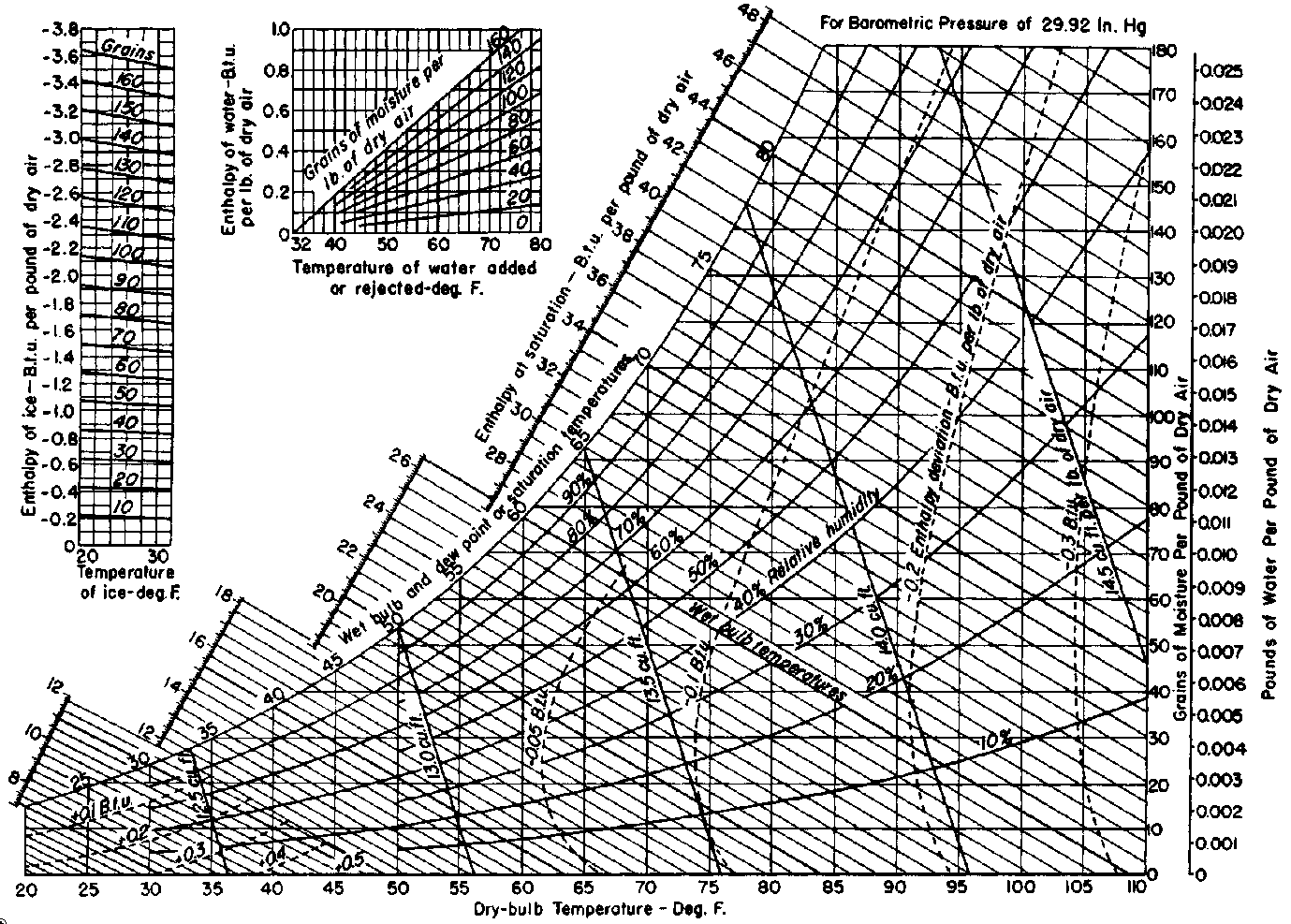
While I don't know beans about predicting weather I do know that the rain that falls in one location started out as water vapor absorbed into the air somewhere else. Here is an NOAA loop of water vapor as it starts over the North Pacific and swirls to the East across the upper USA. The psychometric chart demonstrates that as air increases in temperature it's saturation point for water increases exponentially so a small increase in air temperature can make a large increase in the amount of water a mass of air can hold.
That swirling warm humidified air mass then has to mix with another colder air mass to make the water vapor condense out as rain. Otherwise the humid air would just pass right over without any rain falling. There needs to be a ongoing collision of a warm humid air mass and a cold one to generate the persistent and massive rain we have seen lately here. As long as there are polar ice caps, there will be cold air masses, and where those cold air masses collide with warm humid air masses there will be rain.
The warmer ocean temperatures and warmer atmosphere combine to increase the amount of moisture the atmosphere holds increasing the potential for monsoon-like weather when that warm humid airstream meets up with a cold front. Predicting exactly where, when and how much rain will fall is beyond our modeling capability but it is reasonable to say that as the ocean temperatures rise from the effects of AGW, we will see more rain, not less. And as the slow march of AGW affects ocean and wind currents, there will be regional changes in traditional weather patterns. Better or worse, the climate is going to change everywhere.
There are some 6 billion people on the planet and each one of us is using some amount of energy derived from fossil fuels every day. That process involves creating carbon dioxide, a greenhouse gas that holds heat in the air, and waste heat that goes into the air and eventually into the ocean. While an increase in temperature of the oceans might seem slight, there is a flood of data to demonstrate the exponential increase in the amount of evaporation resulting from warmer oceans and air.
Showing posts with label Environment. Show all posts
Showing posts with label Environment. Show all posts
Thursday, May 26, 2011




Thursday, May 19, 2011
CAFE Math.. Why the gas hogs have to go.
Over a year ago the EPA released the new Corporate Average Fuel Economy standards going forward. New Federal CAFE standards officially released, 34.1 mpg by 2016
And that doesn't sound like all that much of an increase from 2011's standards of 30.2 mpg for cars and 24.1 mpg for light trucks. But a bit of math shows that this is not going to take just some minor tweaking here and there. It is going to be very difficult, or at least expensive, to keep on offering high performance vehicles with poor fuel economy. The key detail is in how the CAFE number is calculated. The average fuel economy is a weighted average of the harmonic mean, not the arithmetic mean of the mileage ratings of the individual vehicles. I'll let the NHTSA website explain it to make the math clear..
Hopefully we will actually get to see what a 50 mpg vehicle looks like sometime soon, at least in concept, seeing as in a few years they will have to comprise about half the total fleet. That is unless manufactures go ahead and penalize customers who want a vehicle that gets only 30 mpg to cover the gas-guzzler penalty.
The harmonic mean method for calculating the CAFE number puts a severe penalty on vehicles with relatively low mileage because they drag down the overall mileage average. As an extreme example consider that the average between 1 mpg and 100 mpg is only 2 mpg. To acheive the 2016 CAFE requirement of 28.8 mpg for light trucks, manufacturers will have to sell one truck that gets 39 mpg for every for truck that gets 23 mpg. Seeing as there is no truck that can get close to 39 mpg now it will be a real challenge to rely on that vehicle for half the sales of light trucks. Either that or the approach will have to be increasing the efficiency of the lower mileage vehicles and there is no easy way to squeeze much more economy from a full size V8-powered pickup truck with current towing and weight capabilities.
True there are some substantial mileage credits manufacturers can get by offering flexible fuel vehicles, but soon those will diminish unless automakers can demonstrate that drivers are actually buying the E85 fuel, which they aren't. It may be cheaper per gallon but it provides less fuel economy so it ends up more expensive per mile and truck owners are savvy enough to figure that out. So I don't look for the flexible fuel credit to be the savior that enables a full portfolio of light duty trucks to meet CAFE long-term.
To comply with 2016 CAFE standards manufacturers will have to keep pushing the limits of engineering and technology to get maximum fuel efficiency out of each vehicle. But the way I see it, all of the best efforts of the automakers will not do enough to elevate the fleet average to enable the continued offering of high performance and full sized vehicles in significant volume. The low mileage vehicles will be purged from the lineups except for the high end vehicles that can command the gas guzzler premium from customers.
So get used to those little B-class subcompact vehicles. Good chance you'll be driving one in a few years.
The overall fleet fuel mileage requirement will be an average between both passenger cars and light trucks, and NHTSA is predicting that the 2012 numbers will be 33.3 for cars and 25.4 for trucks in 2012, rising to 37.8 for cars and 28.8 for trucks by 2016.
And that doesn't sound like all that much of an increase from 2011's standards of 30.2 mpg for cars and 24.1 mpg for light trucks. But a bit of math shows that this is not going to take just some minor tweaking here and there. It is going to be very difficult, or at least expensive, to keep on offering high performance vehicles with poor fuel economy. The key detail is in how the CAFE number is calculated. The average fuel economy is a weighted average of the harmonic mean, not the arithmetic mean of the mileage ratings of the individual vehicles. I'll let the NHTSA website explain it to make the math clear..
The regulatory language describes the calculation as: “the number of passenger automobiles manufactured by the manufacturer in a model year; divided by the sum of the fractions obtained by dividing the number of passenger automobiles of each model manufactured by the manufacturer in that model year by the fuel economy measured for that model.”SO, based on that explanation, feel free to dive in and calculate the fleet average for a manufacturer that sold equal numbers of vehicles with 50 mpg and 30 mpg. That would make the fleet average 40 mpg right? Uh, not so fast. According to the definition you have to calculate the fleet average based on gallons-per-mile, not based on miles-per-gallon. The answer to the problem is 37.5 mpg, which just so happens to be close to the 2016 standard for passenger cars. To comply with the CAFE standards in 2016, manufacturers will have to sell as many vehicles that get 50 mpg as 30 mpg.
Hopefully we will actually get to see what a 50 mpg vehicle looks like sometime soon, at least in concept, seeing as in a few years they will have to comprise about half the total fleet. That is unless manufactures go ahead and penalize customers who want a vehicle that gets only 30 mpg to cover the gas-guzzler penalty.
The harmonic mean method for calculating the CAFE number puts a severe penalty on vehicles with relatively low mileage because they drag down the overall mileage average. As an extreme example consider that the average between 1 mpg and 100 mpg is only 2 mpg. To acheive the 2016 CAFE requirement of 28.8 mpg for light trucks, manufacturers will have to sell one truck that gets 39 mpg for every for truck that gets 23 mpg. Seeing as there is no truck that can get close to 39 mpg now it will be a real challenge to rely on that vehicle for half the sales of light trucks. Either that or the approach will have to be increasing the efficiency of the lower mileage vehicles and there is no easy way to squeeze much more economy from a full size V8-powered pickup truck with current towing and weight capabilities.
True there are some substantial mileage credits manufacturers can get by offering flexible fuel vehicles, but soon those will diminish unless automakers can demonstrate that drivers are actually buying the E85 fuel, which they aren't. It may be cheaper per gallon but it provides less fuel economy so it ends up more expensive per mile and truck owners are savvy enough to figure that out. So I don't look for the flexible fuel credit to be the savior that enables a full portfolio of light duty trucks to meet CAFE long-term.
To comply with 2016 CAFE standards manufacturers will have to keep pushing the limits of engineering and technology to get maximum fuel efficiency out of each vehicle. But the way I see it, all of the best efforts of the automakers will not do enough to elevate the fleet average to enable the continued offering of high performance and full sized vehicles in significant volume. The low mileage vehicles will be purged from the lineups except for the high end vehicles that can command the gas guzzler premium from customers.
So get used to those little B-class subcompact vehicles. Good chance you'll be driving one in a few years.
Subscribe to:
Posts (Atom)